Sunday, August 13, 2017

Diastasis Recti - What to do.

At 19 months postpartum, I was certainly back to pre baby weight and size, but I still had "the gap." At this point it had healed some, but I was still experiencing many of those previously mentioned symptoms. Thankfully, my first appoint at physical therapy was so empowering and enlightening. Not only were there things I could do to help heal my gap, but there were also steps I could make to prevent it from possibly occurring or at the least being as severe during my next pregnancy.  For example, the doctor recommended wearing a support band during pregnancy from about 5 months forward (if not regularly, at minimum during activity). She explained that a support band helps keep the abdominal muscles trained in place instead of allowing them to shift to the side.

The doctor also advised that women who breastfeed experience healing much later than women who don't breast feed. While nursing helps the uterus to shrink and burns additional calories for mommy, it also continues to encourage the production of muscles and tendon relaxing hormones. These hormones don't make your Diastasis Recti worse, but certainly delay the natural healing process until after baby has been weaned.

During our first session I was provided a treatment plan, which has been built on each week. While this treatment plan was recommended specifically for me and should not replace an actual personalized treatment plan, I felt sharing some of the exercises may be a helpful examples of what healing exercises could look like.


The last recommendation the doctor made is my personal eye roll worthy activity... She so ever fervently advised the regular practice of kegel exercises; regular as in every stop light while driving and after every potty break. Ugh... Not my favorite for sure and certainly skipped more than I care to admit.  She of course shared a handful of other exercises, strategies and details, but in honor of keeping these short, I call this the end. Maybe other Mom's can share theirs. Hope this helps!  

Diastasis Recti... Say what?

Sooooooooooo.... I spent so much time preparing for baby that I completely ignored/overlooked issues that affected just me.  I remember I first learned about diastasis recti (abdominal splitting) at my 2 weeks post delivery check up with my midwife. She put her fingers on the middle line of my belly pushed down and said, "the gap is 3 fingers."   "Um, what gap?"

Diastasis recti is essentially when your abdominal muscles divide and move to the side in order to accommodate your ever growing baby bump. It effects 30% of all pregnancies and your chances of developing it increases when you yourself are small, deliver a high birth weight baby, have had multiple pregnancies, or are over the age of 35.

   So my earlier question, "What gap?" fled my thought process just as quickly as it had fallen into my lap until about 6 months post partum the question returned.  I had all of these other symptoms that weren't going away.

Here are some sample symptoms:

- pregnant belly look (even if you were back to or lower than pre-baby weight)

- belly bulge when cough or laugh

- urine leakage

- muscle weakness

- hernia or risk of hernia

- lower back pain

- pain during intercourse

- constipation

I had a good handful of these and my three finger gap had only reduced to a two finger gap. This of course sparked my traditional research binge routine, but this time, it ended with just more frustration. Everything I seemed to find contradicted each other. One personal trainer said, "do planks." Another would say, "planks make it worse." So, in fear I would make it worse, I scheduled an appointment to see my main care physician.  She advised me that it could take up to 12 months to heal and recommended kegels (sigh) and no abdominal workout until the gap naturally reduced.

...and there I sat until I returned to the doctor at 19 months post-partum with a 2 finger gap and demanded a referral to a physical therapist. This sitting and waiting was not fulfilling.....

Natural Birth

By: Tedi McVea

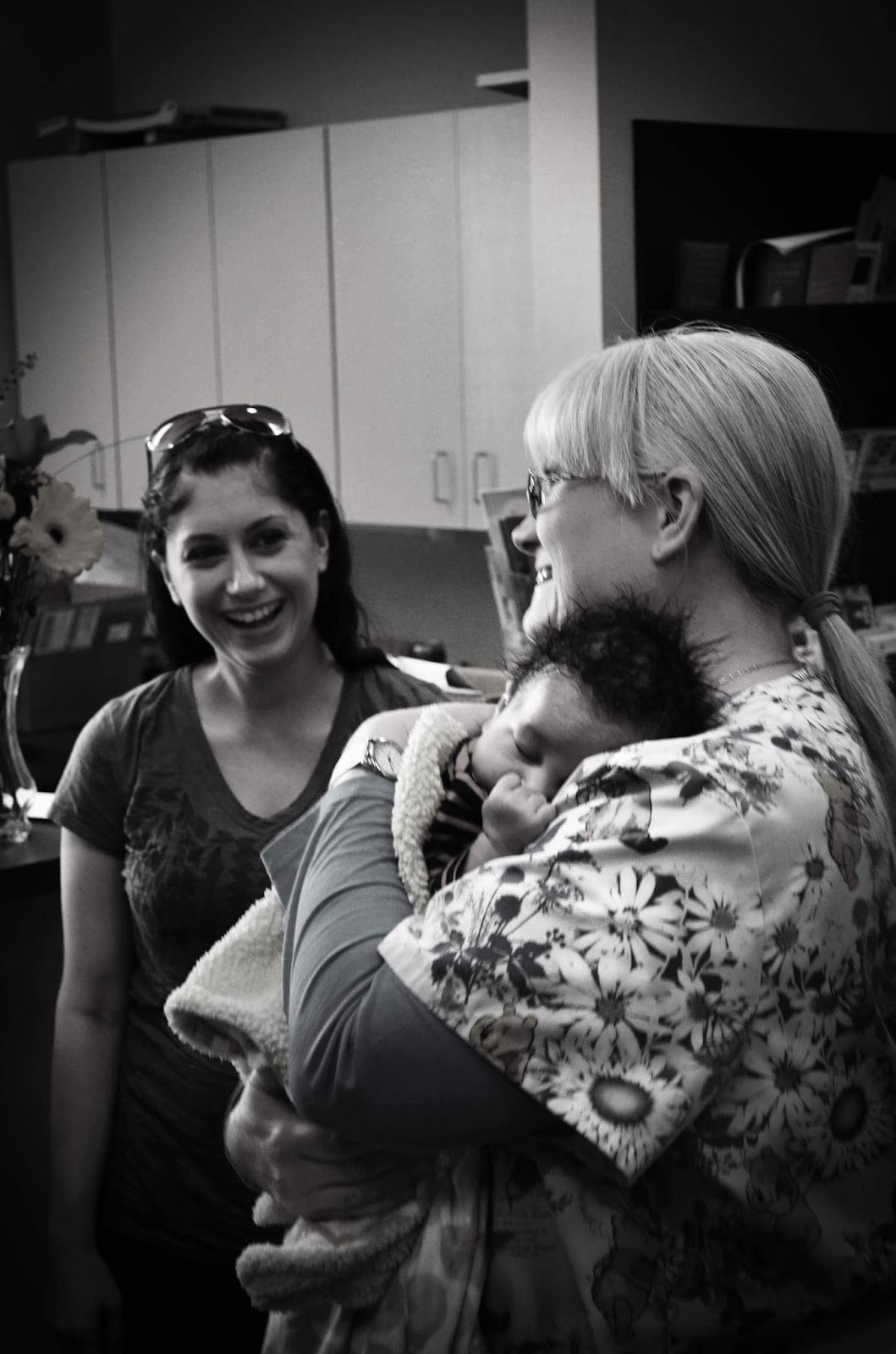
Photos from our final appointment with our Midwives at Birth Center Stone Oak. 

I knew from the start, I wanted to have a natural birth with a midwife. I had toured a birthing center and paid our deposit just weeks after our positive pregnancy test. I was ready. I knew childbirth would be painful, but my logic was the majority of women in the world deliver babies at home either unassisted or with midwifes. In fact, the US is a minority for choosing to treat childbirth as a medical condition.

I repeated the mantra, “if the majority of women in the world could do it, so could I.....” and I did.  It was beautiful! I will choose a natural birth with a midwife again. The labor and delivery of my little bear, while painful, was my favorite part of pregnancy. Something about it made me so proud. I became utterly aware of the amazing lengths my body could go and what it could achieve.

Interestingly, when I shared my delivery plan with family and friends literally everyone tried to talk me out of it. They discussed how painful birth was, how scary birth can be, how unprepared a midwife was for a medical emergencies and so on.... While all of these concerns were shared with love, no one was asking questions about why I chose this option. I was easily able to dispel many of their concerns, for example:


- Our midwife coordinates with a medical doctor via phone throughout my labor as needed


- The midwife has access to oxygen and IV fluids


- If needed, my midwife would accompany me to emergency delivery (hospital) and assist as needed


- Pregnancy complications may warrant me being required by the midwife to deliver in hospital

and so on.....

But, this same level of scrutiny is not given to hospitals. I guess as a culture, we just assume they are thinking of the birth mom and baby first. Well, here is my truth bomb. Hospitals are expensive businesses to run. Lets say that again, they are a business with lots of overhead: doctors, nurses, equipment, facilities, etc. The quicker they move moms through labor and delivery, the quicker they can fill those beds with a new mommies. They also operate from a position of reducing liability. In a time where litigation is a real issue, hospitals have policies in place to reduce their risk of liability as oppose to individualizing the birthing process to mommy and baby. This manifests itself by using prescriptions to attempt to speed up labor, transitioning to cesarean before trying other alternatives, and forgoing natural treatments such as vaginal massage, oils and lubricants to prevent tearing.

I wanted an individualized birthing process. I didn’t want a plan. My plan was to follow what my body needed and my body needed 25 hours to labor, back pressure, arnica oil, vaginal massage before the last big push, a big bath tub for labor, and lots of eating/drinking throughout.

Every woman has a right to design and choose her own birth plan. A hospital may be part of your plan, an epidural may be part of your plan, Pitocin may be desired to speed up your labor.... My goal in sharing my plan and experience is to remind people that it is not a foreign, crazy, or dangerous choice to deliver at home, in a birth center, or with a midwife. In fact, it is the natural way our bodies were designed to birth babies. My wish is that women are making the choice that best fits them and not choices based on fear, societal pressure or the business plan or defensiveness of a hospital.

Tricky People and Safety Planning

Contributing Writer: Devin Rojas of New Jersey

Children don’t benefit if they’re taught to be afraid of the world. The point of teaching tricky people over stranger dangers is to teach children to read situations and people and know how to act accordingly.  Child are still left at risk if we limit our lesson to stranger danger and limit our safety planning to "running away" or "not talking to strangers." Those solutions just don't get to the heart of the highest risk.

Approaching safety conversations from a tricky people perspective:
  • Helps a child understand the red flags of a dangerous person
  • Gives them a chance to ask questions and practice scenarios
  • Opens a dialogue with the parent’s about the nature of the child's relationships. 
These ongoing conversations will give a child the tools they will need to keep safe if they ever encounter a sex offender.
Part of teaching tricky people is also deciding what will be done once a tricky person has been identified. Teaching children to develop a safety plan is such an important part of life. They already learn this skill when they’re mapping out fire exists in first grade, so now we just translate that to interpersonal safety. 

1) Is this a tricky person who’s contact I can control as a parent? Such as a neighbor or friend’s parent? Then I can just move play dates to my house. 
2) Is this a tricky person who’s contact I can’t control, such as a teacher or coach? Then maybe I need to increase my presence as the school, and have my kids put the buddy system in place. 

A lot of what we look for in tricky people may not be "reportable," but we can still safety plan though.  

Tricky people reinforces your child listening to their gut instincts regarding a person or relationship. Children can talk to their friends about that person and make a pact to never be alone with that tricky person. They can look out for each other and make sure other children aren’t being pulled in. With the most important piece being that an adult is aware that this tricky person makes a child feel uncomfortable
Photo by: http://www.jessfielderphotography.com/


Monday, July 31, 2017

Stranger Danger vs. Tricky People

Contributing Writer: Devin Rojas of New Jersey

I’ve never liked the lesson “stranger danger”. We’re a military family, we’ve moved to new locations several times, people move in and out of the street faster than I can switch a load of laundry. Police and child protection investigators are people I teach my kids to trust. Nice moms at Target when you’re lost, waiters, the mailman, Santa Claus... all these people are strangers. Do I go through the world telling my kids that they’re dangerous by nature of being strangers when research shows that children are far more likely to be harmed by someone they know and trusts? I strongly believe in using facts and evidence to guide my parenting in addition to instinct. The facts are that 1 in 4 women and 1 in 6 men report being sexually abused before they were 18 years old, and that 73% of them didn’t report it for a year and 45% for five years. Those numbers alone tell me that there is a reasonably high likelihood of one of my children encountering this, and that I may not know about it.

If we know this then why are we still teaching stranger danger? I have already had many “talks” with my children. I started the moment they could talk with “good touch, bad touch”. I believe it’s never too early to teach children. They are now 9, 6, and 2 and we still have these conversations regularly. A few years ago friend shared an article about tricky people which really gave me the language to help my then 6-year old know what to look for. So, what are tricky people?

Tricky people are people who:
·  Seem far too old to be interested in your kid.
·  Tell your kid to keep secrets
·  Make your kid feel guilty, who encourage your kid to do things they don’t want to do. 
·  Don’t listen to your child/s boundaries. 
·  Try to get your kid alone. 
·  Encourage kids to break family or household rules, they may ask kids to hide things from their parents.
A tricky person can be the nice mom next door who sneaks extra candy to the kids after the parents have asked her not to, then tells kids its their little secret.  A tricky person may be the soccer coach who asks your son to stay late to help with a project, but that he must keep the project a secret. A tricky person may be the grandparent who continues to have tickle fights with a child, despite the child having told the grandparent multiple times that it bothers them.


Photo by: http://www.jessfielderphotography.com/

Tuesday, July 18, 2017

I'm not Superwoman, Pass Me Any Dose of Energy Please.

I have mentioned this before in other entries, but our Baby Bear was the result of fertility treatments. There were a lot of rules our doctor recommended, one of which was quitting caffeine. When you are paying thousands of dollars to get pregnant, its a big motivator to follow any rules that can increase your chances of a successful pregnancy. Quitting alcohol, no brainer. Reducing soy, no biggy. No raw lunch meat, not an issue for this vegetarian. Quitting caffeine, um...... say what? GULP.

Okay, so the first weekssssssssssssssss were hard. I swear I had cravings and withdraws for nearly a month. The beauty of the timing was that I was also very morning sick, so I couldn't caffeinate even if I wanted to. At that time if it wasn't a berry or ginger ale, I didn't want to eat it anyway.

Through my pregnancy, once I climbed out of those horrible withdraws, I found that being caffeine free actually increased my energy level. I was less anxious, didn't crash mid day, and in general got more energy from food then before. Post baby, I nursed so the motivation to stay caffeine free continued. I craved certain sodas or drinks on occasion but was able to resist the urge. I plan on having another baby and hate the idea of going through withdraws again....

But as we all know, being a Mom is exhausting. No sleeping through the night, unpredictable hours, minimal down or self time, still a household, career and social life to attempt to maintain.... There is only so much a person can literally do. This is where the temptation to drink caffeine again certainly comes in.

I'm not superwoman, pass me any dose of energy please. 


These bad boys are AAAAAAAAMAZING!


The Solaray, Two-Stage, Time-Release Mega B-Stress vitamins are this Mom-ease secret weapon. The go for about $15.00 on Amazon but here is the secret, its the "two-stage, time-release" that makes these amazing.  There may be other brands that offer this, but these vegetarian capsules were in my budget. I take three at lunch and within ten minutes I have new energy that lasts me until bedtime. The energy is wonderful because it does not come with anxiety like caffeine and feels more like a second wind.

Monday, July 17, 2017

Postpartum Recovery- Why is this such a secret?


The absolute hardest part of my pregnancy and birth was the postpartum recovery. This is true for most first time moms, yet no one ever talks about it. And why? I certainly could have used the heads up... There is so much build up to the birth and "how horrible and painful" it is, that no one seems to think it is important to mention what recovery looks like for vaginal births.  This entry will be my attempt to break that secret wide open and prepare some new mommies.

So, here are 10 of the ugly truths.

1) Bleeding (lochia) - There will be bleeding and lots of it. Not just a "period flow," but a "you just pushed a tiny human out of your uterus flow."  After a few days, the bleeding tapers off significantly, but most women bleed for 2-6 weeks.

2) Diapers - You will need diapers and not just for that adorable Little Bear, but for you! Not liners, not pads, but diapers. I was in diapers for about a week and then I was able to taper down to pads.

3) Soreness - You will be sore. I was sore for about 4-6 weeks post baby. The first few days hurt to sit,  but you gradually get less and less sore as days pass. This is one of the reasons first-time Mom's delay sex for about 1-2 months post baby (some longer), because they are still tender.

4) Stool Softeners - Yes, that tenderness means pushing for #2 can feel very scary! Once you get one poop down, you will be golden for the rest, but that first one can be scary. Stool softeners help.  They are your training wheels for pooping again.

5) No Toilet Paper - Many midwifes and doctors recommend not using toilet paper or wipes for the first few weeks to help prevent additional tearing or infection. Many women use a rinse bottle to clean themselves after bathroom breaks.

6) Baby Blues - I feel like there has been an increase in awareness of postpartum depression, but it has come at a cost. Women are forgetting about "baby blues." All women get baby blues and it is different from postpartum depression. Baby blues is a term used to describe the depression, anxiety and just general moodiness that comes from the quick shift in hormones, lack of sleep and physical recovery of delivery. Postpartum depression is defined by an attachment issue with baby and not exclusively for feeling depression symptoms.

7) Abdominis Rectus (Split abs) - This condition is super common. Sometimes a mom's abs get pushed to the side to make room for baby to grow, and then post delivery she will be tender and sore from not having those muscles in their original place. Many moms find using a postpartum belly wrap or binder helpful as an external support, while those internal muscles find their way back. The binder wont be "needed" after 1-2 weeks, but having one will certainly help you walk around those first few days.

8) Breastfeeding - Nursing can be complicated in the beginning. How could something so natural be so difficult for so many woman? I won't dive into this one too much because honestly it needs its own entry, but it is normal to have a few days of painful, bleeding nipples. So don't freak out or give up. Its very temporary.

9) Bladder Weakness - Your bladder will never be the same and ya, you may pee on yourself more. Some Moms are able to strengthen their pelvic floor muscles pretty quickly and resolve this issue in a few months, but others deal with a longer period of "oops" urine leakage.

10) Driving - Women are recommended to not drive for about six weeks after delivery of their first child. This isn't always possible logistically for some families, but the muscles used to drive are significantly weaker and can effect your ability to respond quickly.

Overall, this entry was not meant to scare you. Trust me, you will be in heaven the moment you stare into those little eyes and hold those baby fingers. You wont be thinking as much about yourself or your pain.  Additionally, you will have tons of awesome hormones and such helping your amazing body (that just grew that perfect baby) do just as amazing of a job recovering.